

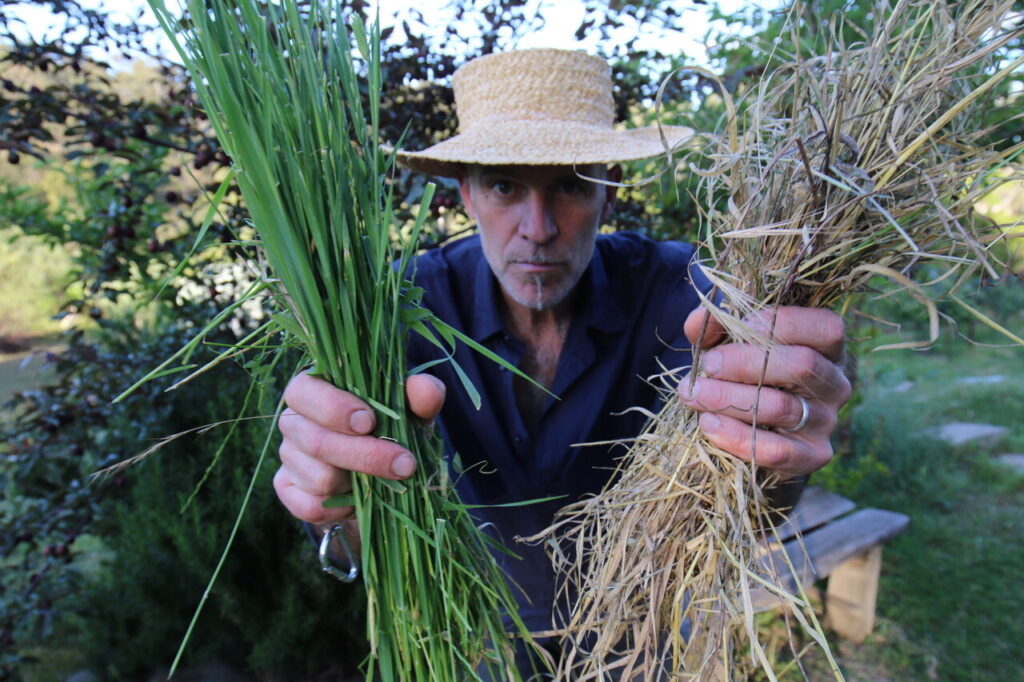
With the fertility of spring drawing to a close and the dry of summer approaching, we often find ourselves with lots of dry grass to deal with. So, what role will it play in our compost?
It is easy to think that if a compost ingredient is dry and brown, it must be on the carbon-rich end of the spectrum, but dry grass is one of those (many) exceptions to the ‘greens/browns’ rule.
Like hay, grass cut green and dried as a high-protein (high-nitrogen) animal feed, the grass we cut and let dry (either deliberately or accidentally) will be a nitrogen-rich ingredient in our composts. Just how high in nitrogen will be determined by how far into its seeding it was when we cut it.
Grass cut while there are only green blades growing will be very high in nitrogen. As the plant begins to put its energy into sending up a stem and seeding, much of its nitrogen will be concentrated into the seed, while the stem of the grass will be higher in carbon.
So, when we add dry grass to our compost we need to balance it with carbon-rich ingredients, like straw (which are those woody, carbon-rich stems of a cereal crop, with the grain removed), autumn leaves or aged woodchips. Dry grass will have less water in it than when fresh, so we might need to add water when layering it into our composts.
Texturally dry grass can be deceptive. It feels like it will add aeration and structure to our pile, but, once it re-wets in the compost it can quickly become a soggy collapsed mess, much like fresh cut grass can in a compost pile.
If it was cut late in its seeding cycle and has lots of woody stems, it will be less prone to collapsing, but we do need to take care to chop it up enough (15cm maximum, but 5 – 10cm better) before we add it to our piles. Left uncut, those long fibres will be a nightmare when we come to turn our compost.
Pea straw has similar issues to dry grass. Although technically straw, not hay, pea plants are a great nitrogen ‘fixing’ plant, and even their stems are pretty nitrogen-rich.
Although people do buy pea straw for their composts (and some sources even recommend it) pea straw is not a carbon-rich ingredient, doesn’t add much moisture to our piles, and once re-wetted, will collapse structurally and add little aeration or body to our compost.
If we are adding the pea straw in the mistaken belief that it is a carbon-rich ingredient and we also add lots of food scraps and other nitrogen-rich resources, our compost will be stinky and airless.
Pea straw can make a great garden mulch, but is best left out of our composts. If we choose to use it, we will need to add a good dose of carbon-rich, structural ingredients to balance it.
– Joel Meadows works with *Yes In My Back Yard, (YIMBY), a community-scale composting initiative in Castlemaine and surrounds. Send questions or comments to hello@yimbycompost.com, or to book in for a compost workshop.