

Maldon residents concerned about an increase in mining activity in the area have formed an alliance calling for greater transparency and regulatory oversight from the Kaiser Reef Maldon Gold Project.
The mining company bought the mine and processing plant in 2021 and is currently undertaking exploratory work to identify priority targets for further geological investigation.
President of the Maldon Community Alliance, Kate Gamble, said their group, along with other Maldon residents and members of the Bells Reef Residents Group, was concerned about current operations and the considerable expansion of the Kaiser Reef Maldon Gold Project that the company proposed.
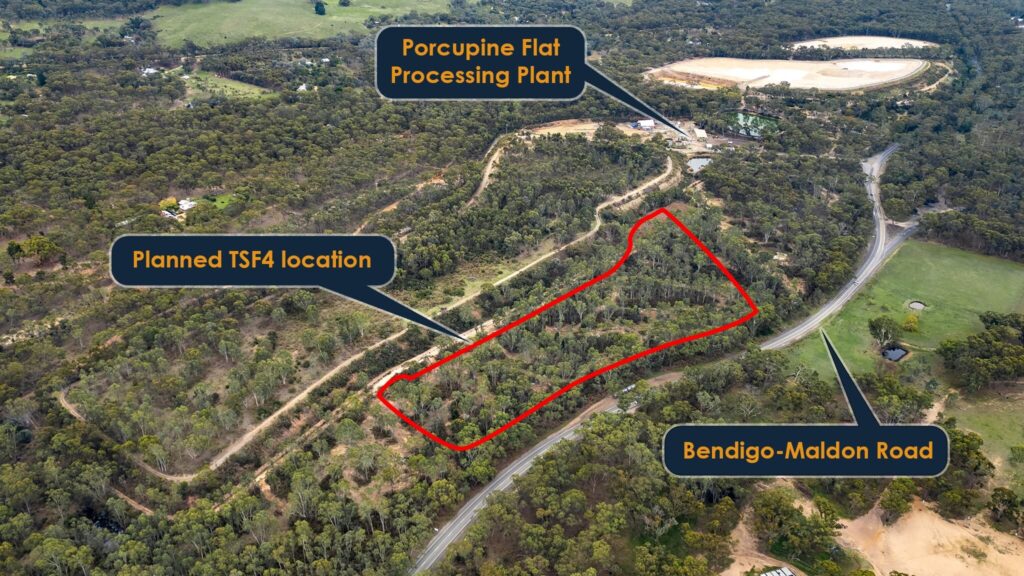
“The expansion includes tunnelling in multiple directions from the Union Hill mine site to take in a large area of Maldon, with access from a new decline as well as the construction of a new tailings dam on the Bendigo-Maldon Road at the Porcupine Flat Processing Plant site and a significant expansion of waste storage on site,” Ms Gamble said.
“Given the proximity of Union Hill to existing and recently developed residential areas as well as the historic township of Maldon, and the location of the nearby processing plant, both the current mining and processing operations and planned expansion raise grave concerns.
“The health, safety, economic livelihood and wellbeing of residents and local businesses, as well as the natural environment, are being significantly compromised.”
Concerned about the legacy permits, originally issued in 1986, and a tailings dam permit, approved in 1997, the alliance wants to ensure the works are capturing the modern landscape. They would like more opportunities for community consultation and a more rigorous environmental assessment, as would occur at any new sites.
“This planning permit is now close to 30 years old, and the Maldon landscape has changed markedly over that time, as has the regulatory landscape. There is a notable increase in the number of residences in close proximity to the mining activity, and far greater understanding of the impacts and dangers of the processing plant and the toxic waste it produces, on residents in surrounding areas,” Ms Gamble said.
“The mining activity itself creates almost constant noise, dust or mud depending on the season, and extraordinary stress for neighbouring residents, given the operation runs six days a week. The blasting has been particularly impactful on some residents, and felt quite widely around the town.”
Resources Victoria
The Express contacted the overseeing body, Resources Victoria, which said it was ensuring the state’s stringent mining regulations were met at Kaiser Reef and was working with several agencies to monitor compliance, including dust, noise and water flows.
“Mine operators are required to monitor surface water, groundwater, noise, dust, and ground vibration, with results reported to Resources Victoria and an Environmental Review Committee,” a Resources Victoria representative said.
“The mine operator has applied through the work plan variation application process to construct additional tailings storage facilities (TSF). The application is subject to review by Resources Victoria and other relevant agencies. If approved, the TSF’s will need to comply with the current national standards for their construction and operation as outlined by the Australian National Committee on Large Dams Guideline.”
Kaiser Reef
Kaiser Reef Maldon Gold Project general manager Dylan Morgan said Resources Victoria was also represented on the Environmental Review Committee, where they received detailed quarterly updates and environmental monitoring results.
Mr Morgan confirmed that the Porcupine Processing Plant operated under a work plan and planning permit that were originally granted in 1986, but said there had been seven approved amendments since 1997, with the most recent in 2017.
“All works undertaken must still comply with applicable contemporary environmental and regulatory requirements,” he said. “Kaiser Reef takes these responsibilities seriously and operates in accordance with a detailed Environmental Management Program.
“This includes extensive monitoring of surface water, groundwater, noise, dust and ground vibration. Results are reported quarterly to our Environmental Review Committee.
“In total, we monitor dust in 13 different locations across town and around our operations, and monitor noise in four different locations with continuous noise monitors. We also regularly conduct ad hoc noise surveys with handheld monitoring.
“On top of that, we monitor groundwater in 16 different locations and surface water in 18 different locations, including all creeks upstream and downstream of our operations and any standing water catchments, including the South German Dam.”
Mr Morgan said that while the work plan and planning permit for construction of the new Tailings Storage facility was approved in 1997, the design, construction, operation, management and rehabilitation had to comply with applicable contemporary environmental and technical standards.
It feels like an earthquake
A member of the Bells Reef Resident Group, which was founded in 2012, said they felt like they were fighting a losing battle.
“The noise is already going 24/7 from Monday to Thursday, and now that there is new drilling and the tailings dams are being expanded, it’s going to be three and a half times worse,” they said.
“They have a massive mining licence that covers Parks land, Crown land and underneath the whole of the surrounding residential land – we’re going to be surrounded.
“When they drill under people’s houses, everything shakes, and it feels like an earthquake. Some houses have cracks in their roofs and walls.”
Living near the mine site for the past 20 years, the resident said the constant noise from the new blasting had reached a point where they didn’t want to come home.
“The real cost of gold mining is on the residents,” they said.