

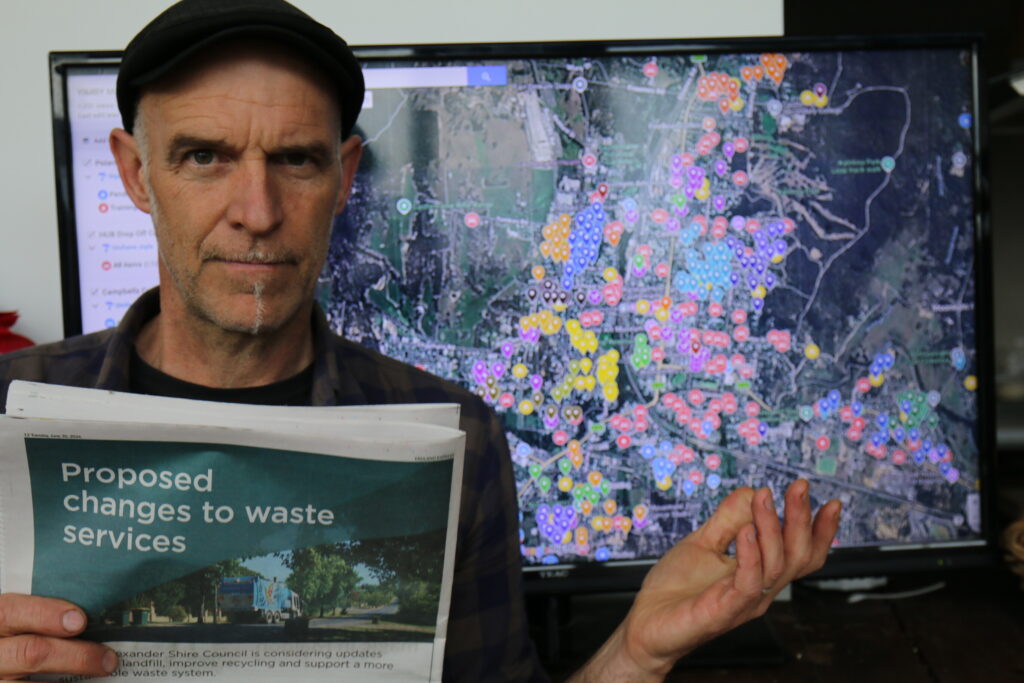
The statewide rollout of a new four-bin system is creating a stir across Victoria, with many councils expressing concerns that the glass recycling system is unnecessary and costly.
In Mount Alexander Shire, however, the issues with glass bins are secondary to the introduction of a FOGO (Food Organics Garden Organics) bin system, as local composters call on the council to slow down.
Earlier this year, Castlemaine-based composting group, YIMBY Compost, submitted a petition to the council with more than 1000 resident signatures, asking it to slow the process and allow time for more conversations and information gathering about how food and garden waste is handled locally.
Mount Alexander Shire Council made a public announcement last week that it was considering introducing a glass drop-off network and opt-out FOGO bin system across the shire and advertised an information session about the proposed system at the Castlemaine Town Hall on Wednesday July 8.
YIMBY Compost co-founder, Joel Meadows, said the group was disappointed the council had chosen to inform residents rather than consult.
“An information session isn’t consultation, and there’s no council vote behind this yet. The real decision is still ahead of us, and there’s still time to get it right.”
Mr Meadows said YIMBY was not opposed to FOGO in principle.
“If a standard FOGO system turns out to be the best fit for this shire, we’ll accept that. What we want is a decision built on real evidence and collaborating with the community,” he said.
Mr Meadows said the real risk wasn’t only to YIMBY’s large and growing group of participating households – it was to home composting in Castlemaine more broadly. Once every household has easy access to a kerbside bin, fewer people keep composting at home at all, whether through YIMBY or quietly on their own, and a much larger, less visible shire-wide practice that reduces waste and enriches local soil could be threatened along with it.
“Home composting is the gold standard for this shire, not just for YIMBY,” Mr Meadows said.
“That’s exactly why the evidence needs to be nailed down before anything’s locked in. We think there’s a better way through this, and we’re putting together something substantial to bring to council and the community in the coming weeks.”
In a letter to the Express (see page 20), MASC’s director of infrastructure and development, Michael Annear, said too much organic waste was going to landfill.
“There is also a clear statewide push in this direction. Victorian Government policy requires councils to move to a four-stream system – separating general waste, mixed recycling, glass and food and garden organics. The question for council is how to implement this in a way that reflects the needs and expectations of our community,” he wrote.
“We are considering introducing two new services in 2027: a weekly Food Organics and Garden Organics (FOGO) collection and a network of local drop-off points for glass. At the same time, general waste would move to a fortnightly collection, with mixed recycling also collected fortnightly.”
He continued, noting that the proposed system would not replace home or community composting.
“It’s also important to say that this proposal won’t replace home or community composting. If you’re already managing your food and garden waste successfully, you’ll be able to apply to opt out of the FOGO service. We’ll also continue to support community-led initiatives like YIMBY.
“No final decision has been made. This is about sharing information early, being transparent about the challenges and giving people the chance to ask questions.”
YIMBY, which has grown steadily since 2020, has been acknowledged as a nation-leading initiative: the Local Community Compost Alliance of Australia (LOCCAL) points to Mount Alexander having a “rare opportunity to build on an already thriving grassroots movement,” rather than replacing it with a one-size-fits-all solution.
As at June 2026, the network had 59 trained composters and 657 households contributing food scraps, with another 15 composters currently in training.
Beyond the numbers, YIMBY says the real value is what it builds alongside them: a weekly visit from someone who’d notice if an elderly or isolated neighbour wasn’t coping, skills passed from one street to the next, and, if the network keeps growing, there will be real local jobs to go with it.
Mr Meadows said YIMBY was looking forward to working with Mr Annear in his new role as council CEO, which begins on July 20.
“He’s spoken publicly about wanting to lead an organisation that listens and acts with integrity. A change of this scale, affecting every household in the shire, is worth getting right, and we’d welcome the chance to work with him and council on a solution that gets on with the job and best serves the whole community.”