

What happens when you take democracy apart and ask teenagers to rebuild it?
That’s exactly what local democracy advocacy group Really Local set out to discover through UnAssembly, a new project delivered in partnership with Folio Collective and Castlemaine Community House.
And no, it’s not connected to the United Nations. The name is quite literal: UnAssembly invites participants to unassemble democracy, examine how it works, question its assumptions, and imagine how it could be better.
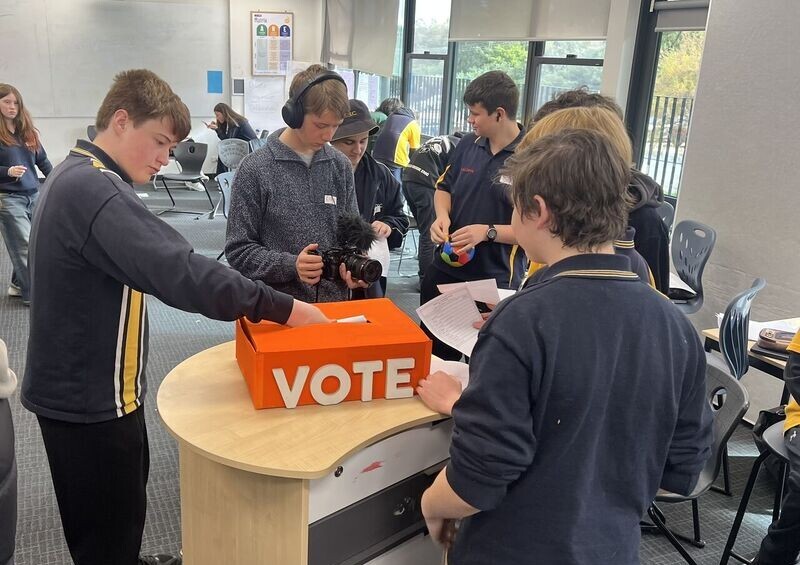
The innovative program recently brought a citizens’ assembly-style experience to year nine students at Castlemaine Secondary College, giving them the chance to learn democracy not from a textbook, but by actively practising it.
Funded through a grant from the Parliament of Victoria via Neighbourhood Houses Victoria, the project saw students tackle big questions about democratic systems, power, participation and decision-making during sessions held at the college on May 20 and at Castlemaine Town Hall on May 27.
Behind the scenes, Folio Collective has spent more than a year developing the program, which aims to revitalise civics education and strengthen democratic participation.
As far as the organisers know, it’s a world first.
Folio Collective program lead Matthew Taylor said the goal was not simply to explain democracy to students, but to hand them the tools to redesign it.
“They get to unpack democracy and reassemble it,” he said.
Really Local lead facilitator Bryn Davies believes democracy is something people inherit but aren’t necessarily taught to practise well.
“Students get the chance to develop democracy skills like dealing with disagreement, reaching consensus and critical thinking,” he said.
Democracy, Disagreement and… Pizza
The first day focused on building the foundations of effective democratic participation. Students established group norms such as respect, open-mindedness and active participation before exploring skills including critical thinking, compromise and constructive disagreement.
From there, they tackled some of democracy’s biggest questions:
What matters most in a democracy?
Who should be included?
Who should make decisions?
How should those decisions be made?
Then came perhaps the most delicious lesson of all: the Pizza Vote.
Designed as a mock election, the exercise used preferential voting to decide what pizza students would eat on day two. Pizza varieties formed the “lower house”, while dietary requirements acted as the “upper house”, keeping proceedings in check.
The exercise generated plenty of laughs — and some genuine political insights.
One of Taylor’s favourite moments came when a student, having just learned how preferential voting works, asked:
“Do I really have to number all the boxes, even the ones I don’t want at all?”
For the organisers, these spontaneous lightbulb moments were among the highlights of the program.
Rebuilding Democracy
Day two shifted from understanding democracy to redesigning it.
Students explored how information shapes decisions, who influences political outcomes, and how democratic systems can hold power accountable.
For Davies, the standout moment was watching students grapple with the challenge of consensus.
Rather than trying to “win” arguments, participants worked together to find solutions everyone could live with.
“The absolute highlight was navigating consensus and seeing the way students offered solutions to help each other reach a position they could live with,” he said.
The program also attracted a number of visitors who shared their own experiences of democracy in action, including Mount Alexander Shire mayor Cr Toby Heydon, Speaker of the Legislative Assembly and Bendigo West MP Maree Edwards, and Bev McArthur MP, who happened to be passing through.
After a day spent reimagining the future of democracy, students were rewarded with the pizzas they had democratically chosen.
Maree Edwards said it was inspiring to see young people engaging so thoughtfully with the democratic process.
“As Speaker, it was wonderful to take part in a program that saw year nine students from Castlemaine Secondary College learn about democracy by doing,” she said.
“The deliberative forum conducted by Castlemaine Community House together with Folio Collective and Really Local was inspiring and will help students become active, capable and responsible citizens.”
If UnAssembly’s organisers are right, the future of democracy may well depend on experiences like these — where young people don’t just learn how the system works, but are empowered to imagine how it could work better.